Saturday, August 19, 2006

Terror Alert


Chaos at Heathrow.


In a previous blog I wrote about the attack on Lebanon, and about the Israeli spin that makes it appear that every problem in the Middle East is the fault of the Iranians: as if it were Iranian aircraft screaming over the Lebanon these last few weeks and blowing up everything that moved.

It was only after I’d finished writing it and had posted it up that I heard about the terror plot and the arrests in Birmingham and London.

I must admit that my first thought was dismissive. Here we go again. Anything to keep Lebanon off the front pages.

What I had in mind was the well-known history of WMDs, of fake dossiers, of the sexing up of intelligence material, of tanks at Heathrow, of Jean Charles de Menezes and Forest Gate and of all the other times we have been lied to or misled in the last five years since this so-called War on Terror was declared.

So now they have replaced real bombs with hypothetical bombs, real threats with hypothetical threats, real death and destruction and attacks upon civilians with a useful scare story designed to keep our minds distracted and our hearts full of fear.

Disrupting our holidays. Testing baby-milk for high-explosives. Ha! It would be ludicrous if it wasn't so serious.

Notice how the terror alert only went critical once the alleged terrorists had been caught?

That’s how I thought.

Well I’ve decided since then to reserve my judgement. Maybe there was a plot, after all. We’ll leave it to the courts to decide.

We’re lucky we still have a functioning judicial system, despite government attempts to dismantle it.

If there was a plot, let the perpetrators be brought to trial and, if they are found guilty, let them be punished for their crimes.

That is the proper way to deal with terrorists, and it always was.

Of course, when anyone attempts to take a rational approach to the current cycle of violence - pointing out how British foreign policy is causing this country to be targeted, for instance - we are immediately accused of giving in to terrorism.

Accepting that there might be grievances is allowing government policy to be dictated by the terrorists, we are told.

Actually it is the other way around. Only by accepting the reality of the grievances – and of the huge errors in British foreign policy which have exacerbated the situation - can the terrorists be separated from the mass of ordinary Muslims who agree with their aims but disagree with their methods.

Tony Blair’s talk of an “arc of extremism” and of “Reactionary Islam”, uniting Hamas and Hizbollah with the Taliban and al-Qaeda, is a dangerous obfuscation which can only lead to more misunderstanding, more violence and more terror.

Occupation creates resistance, whether in Baghdad, Beirut or Birmingham Alabama. It’s as simple as that. It has nothing to do with religion.


*******

Saturday, August 12, 2006

Birth-Pangs


In case you haven't noticed, we seem to be on the verge of World War Three right now.

I heard an Israeli spokesman on the radio the other day. He said: “Iran are causing war and havoc throughout the Middle East.”

Pardon?

I guess those must be Iranian jets flying over the Lebanon at the moment, turning buildings to apple crumble, attacking red cross ambulances and UN peace keepers and killing all those mothers and children cowering in basements. Telling people to move out of south Lebanon and then targeting them in their vehicles. Invading a sovereign nation, pounding the hills with heavy gun fire and attacking densely populated civilian areas. I must have mistaken the flag.

Of course, as we are constantly reminded, Israel has the right to defend itself. True. But not only is the current action way beyond defensive, it begins to look fairly certain that it was premeditated.

It is common to say that Hizbollah started this war when it abducted two Israeli soldiers in a cross-border raid, but, if you wind back the tape a little, you begin to see another picture emerging.

Prior to that Israel were pounding the life out of Gaza, starting with its power plant, a form of collective punishment and a recognised war crime under the Geneva Conventions.

Prior to that Hamas had abducted one Israeli soldier.

Prior to that (though this was barely noticed) the Israelis had abducted a Palestinian doctor and his brother from their home. Abduction of civilians is also a war crime.

Prior to that the Israelis had fired on a Palestinian family sunning themselves on a beach in Gaza.

And prior to that Mahmoud Abbas, the Palestinian President, had almost persuaded Hamas to accept a deal in which it effectively recognised the state of Israel‘s right to exist. Or, to put it another way, by murdering several members of a Palestinian family on a beach the Israelis had deliberately scuppered any chance of a peace agreement.

Ayman al-Zawahiri, the deputy leader of al-Qaeda, was on record at the time urging the Palestinian people to reject the proposals which were to be put to them in the form of a referendum.

In other words, Israel have done al-Qaeda’s work for them.

As to who is behind this war, it may well be true that Iran are arming and supporting Hizbollah, but we all know who is arming and supporting Israel.

Condoleezza Rice says we are watching the birth-pangs of a new Middle East. Since when did you induce a birth by smearing the mother with blood and pounding her with heavy artillery?

What sort of a monstrous baby do the Americans have in mind exactly?

*******


http://www.jewsagainstzionism.com/

You Are What You Eat


According to a recent advert, you are what you eat. Which makes me somewhere between a pork chop and a pot noodle.

This afternoon I was a cheese sandwich. This evening I will be a stir-fry. Next week I will be egg, chips and a slice from Dave’s Cafe down the road. Last week I was a Chicken Jalfrezi at the local curry-house, with poppadoms, pickles, naan bread and Bombay potatoes all sluiced down with five pints of chilled lager and finished off with an after-dinner mint.

Actually the phrase goes back a lot further than that advert.

I first remember it as the title of a progressive rock compilation sometime in the late sixties. Back then it had all the radical edge of a right-on political slogan. It was associated with the burgeoning culture of the hippie movement - all wholefood co-ops and weaving your own yoghurt, squatting empty properties and not washing your feet - and attached to other lifestyle slogans of the time, such as “The Personal Is The Political” and “Pay No Rent”. Far-out guys in baggy flares and cheesecloth shirts were busy setting up wholefood kitchens at their local free-festival where they distributed garlic-flavoured lentil stew for free while raising their hands in the clenched fist salute.

“You Are What You Eat!” they would say - like that, all in capital letters - before slurping down a cup of hot ginseng tea and toking on a joint. “Yeah man, right on, far out, too much.”

Obviously there is a partial truth in this. The chemical constituency of what you take into your body must have some bearing on your physical make-up. If you eat healthily, chances are you will feel good in yourself. If you eat badly, chances are you will feel less happy.

Personally I swear by porridge. A bowl of porridge first-thing usually has me feeling tip-top until mid-morning. Not muesli, note. Muesli is made of uncooked oats and uncooked oats are bad for you, despite their popularity amongst the chunky sweater brigade. Was there ever a breakfast cereal so ridiculously misrepresented?

On the other hand, no matter what you eat, you remain generally a human being. The Masai people of Kenya and Tanzania spend months on end living off a mixture of milk and blood from their cattle, and seem perfectly healthy for all that.

All of which has only the most peripheral bearing on the subject of this week's blog.

The question is not: are you what you eat? It is: are you what you do?


It’s the perennial dinner party conversation isn’t it? You find yourself sitting next to a stranger, and after a cursory summary of the week’s news and what‘s happening to the weather, what else is there to talk about?

So one of you asks the question, “what do you do?” And that’s it: your conversation for the rest of the evening.

The trouble with this is that it is really a conversational ruse, and will tell you virtually nothing about the person you are sitting next to. So you’re a postman, an editor, a line-manager, a social-worker, an interior designer, a taxidermist, a political analyst, a dustman, a pot-noodle quality control inspector are you? All of which tells me how you make your living, not what you think or who you are.

Also, people tend to make judgements on the back of what they hear.


There’s an unconscious recognition of a hierarchy of trades that we all share. An editor is considered better than a postman. A line-manager is considered better than a dustman. Mental labour is considered better than physical labour.

For instance: you all know me as a writer. If I told you my main occupation was as a postman, would that make any difference to how you perceive me? I think it would.

And yet I have done many things in my time. I’ve been a dustman, a road sweeper, a machine operator, a barman, a cellar man, and many, many other things. This used to embarrass me whenever I was called on to write a CV. It made me look inconstant, not to say, inconsistent. It was the CV of a shirker not a worker, a grifter not a grafter, and was only passable as an aid to getting work by glossing over whole years in succession.

It wasn’t until I’d had my first piece of writing published that the CV looked respectable. It was precisely the CV of a writer.

The problem with the question “what do you do?” is that it is always understood only to refer to your method of paying the mortgage. And yet “doing” is what we “do” all the time. I was doing writing long before I ever earned any money from it. I am also “doing” thinking right now. Thinking is as important a part of the writing process as it is of everything else. You do thinking mostly when other people can‘t see you doing it.

Sometimes we do thinking while we’re doing other things. I can think while washing up. I can think while going to the shops. I can think while I‘m in the bath. I can even think while I‘m fast asleep. Sometimes my best thinking is done in this state. I go to bed with a problem, and by the morning it‘s all cleared up.

I have friends who do tarot and others who do magic. One of my friends does nature study while another does music. Are we what we do, or do we do what we are?

Let’s hear what the philosophers have to say on the subject.

Socrates: “To be is to do.”

Sartre: “To do is to be.”

Sinatra: “Do Be Do Be Do.”

*******

Sunday, August 06, 2006

The Tao of Tumble-Driers


In case you don't know, the names of the days of the week are pagan and metaphysical in origin. They are named after celestial beings, mainly either Norse or Roman gods. So Wednesday is "Woden's day", Thursday is "Thor's day", Friday is "Frea's day" and Saturday is "Saturn's day". I don't know where Tuesday comes from. I can't think of any gods of any kind called "Tue". But by the same token, Sunday is the Sun's day and Monday is the Moon's day, both of which are celestial bodies which were once worshipped as deities.

So every day of the week has an underlying metaphysical meaning.

Monday is the worst day, being named after the moon. The light of the moon is simply reflected glory, of course, and moonlight tends to bleed the colour out of things. The moon is connected to lunacy, to moments of dread and confusion and to the urges of the unconscious. In the Tarot-deck a scorpion crawls from a dismal pool while two dogs howl and the moon cries bitter tears. Maybe that's why Mondays always seem so bad.

Traditionally Monday is washing day. Hence the expression "Blue Mondays". The blue comes both from the blue dye that was traditionally used to whiten whites, and from the fact that it makes you feel blue to spend your whole day scrubbing dirty washing with a wash-board and soap, and then wringing the stuff out with a wringer afterwards. Fortunately these days we have the advantage of automatic washing machines to help out with this onerous task. Well some of us do, anyway. I don't. I go to the launderette.

I did consider buying a washing machine. My friend Dodge said he could get me a second hand washing machine for fifty quid, his father-in-law supposedly being a second hand washing machine dealer. Only he forgot. I reminded him, but he forgot again. So I started to think it was probably one of those dodges he is nicknamed for, after his habit of always dodging the question. I started to think that, actually, he couldn't get me a washing machine after all, and he just didn't want to admit it. His constant "forgetting" was just a convenient way of not having to say no. After that I enquired about hiring a washing machine instead. I didn't want to buy a new one as I live in rented accommodation. I thought that a rented machine wouldn't be too expensive, and that it would save me the bother of having to move if I moved house. Have you ever tried to move a washing machine? They're loaded with concrete.

I was wrong. It costs about ten pounds a week to hire a washing machine. The launderette is far cheaper. But it gives you something to do on a Monday morning, doesn't it, sorting out the washing, and then taking it down the launderette. It's a way of reflecting on your week.

So that's where I was earlier this week: in the launderette, listening to the half-awake banter of the launderette attendant, as she made comments about the newspaper she was reading while smoking a cigarette. That's one advantage the launderette has over owning your own washing machine. At least it gets you out of the house.

The launderette attendant was talking about some Italian bloke who'd won £30.6 million on the Italian state lottery.

"How much?" one of the customers asked.

"Thir-ty-point-six million," the attendant repeated, emphasising each syllable with precise relish. "He even predicted the order the numbers would come out in."

The customer said, "how did he do that?"

"Dunno," she said. "I wouldn't be working here if I did."

Meanwhile I was watching my washing shuddering round in the old tumble drier. In the front there was a pink sheet and a green shirt. The two items of clothing completely filled the circular glass screen, twining round and round each other in a kind of pulsating embrace. I thought that the way the pink sheet and the green shirt wound round on opposite sides looked remarkably like the Yin and Yang sign: like two differently-coloured tadpoles in some strange spinning union. It was my makeshift metaphysical moment, there in the all-too physical launderette. And I remembered a time I was in another launderette, a few years ago, when I'd ended up in a metaphysical conversation with one of the other customers.

This was in Glastonbury in Somerset. You have metaphysical conversations all over the place in Glastonbury, even in launderettes. The guy was fiddling the tumble drier by putting a 20p coin into one of those extra-thin plastic bags corner shops and green grocers tend to supply you with. So he was stretching the bag very thinly over the coin, placing the coin in the slot and turning the handle several times before pulling the coin out again. I was watching him, though he was trying to hide it.

"How did you do that?" I asked.

"I shouldn't tell you. Some kids taught me how to do it," he said, looking guiltily over his shoulder. "Is it bad Karma to steal, do you think?"

"I dunno. Maybe. But maybe it's not such bad Karma when you're ripping off the rip-off merchants," I suggested. "Who knows?"

He seemed relieved I'd given him the excuse.

"You really think so?" he said. "I'm worried about my Karma. Only I can't afford to use the driers otherwise."

"I wouldn't worry about it if I were you," I said. "What's Karma anyway?"

"It's the cycle of cause-and-effect," he said. "A bit like this tumble-drier. Round and round and round."

Well I tried fiddling the tumble-driers too, earlier this metaphysical Monday morning, when the attendant wasn't watching. Only it didn't work for me. There must be a knack. Either that, or I already have bad Karma.


*******

Wednesday, July 26, 2006

Dr. Johnson's Refutation

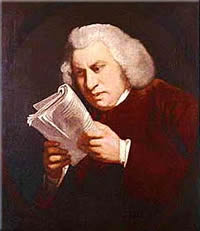
Dr. Johnson at study.


Consciousness is the phenomenon whereby the universe’s very existence is made known.” Roger Penrose, The Emperor’s New Mind, 1989 (1).

I had this peculiar sensation a few mornings ago. I woke up and first thing it was like light bursting into me from the outside, while, at the same time, my consciousness was bursting out into the world from the inside. I felt strangely connected to the moment and, through that, to the whole universe.

It only lasted for a second. After that I wanted to go back to sleep again.

That’s the trouble with consciousness: it’s a purely temporary phenomenon, not to say, exceptionally tiring.

The question is: where does consciousness come from? Does it come from the brain, as some modern scientists would have us believe? In some cases they even go so far as to say that they can locate the exact place - the exact set of cells in the exact part of the brain - where consciousness supposedly resides. (Turn right at the frontal lobe, left at the pituitary gland, and it’s first on your left.)

This is patently false. Take away my brain and you may well take away my consciousness (at least for the moment) but you don’t take away ALL consciousness.

The guy who has just removed my brain remains conscious, for example. He’s standing there looking down at this pulsing splodge of blood-smeared grey porridge in his hands, wondering what on Earth he did that for?

So, while a particular brand of reductionist science would like us to believe that the brain is a consciousness-generator, it could be also argued that it is just as much a consciousness-receiver.

Maybe it’s a two-way transmitter/receiver like a sophisticated version of one of those walkie-talkies the army uses. The question then has to be: where are the Headquarters?


We would have to be a very vain species indeed to assert that we are the only forms of consciousness in the universe. Vain, isolated and stupid. Which, it has to be admitted, is a fairly good description of most of the human race for most of the time.

My answer to this is to say that consciousness could be like gravity or light or time or matter. That is, it is one of the properties of the universe that came into being when the universe was born.

In the beginning was consciousness.

Which brings up another question: namely, where does consciousness go when we are asleep? It still exists, it’s just that we are no longer conscious of it. The brain is still generating images, and our dreaming selves are still ourselves even though we are no longer awake.

Modern psychology refers to this as the Unconscious, which is like defining something by something it is not. It is not conscious. It‘s a bit like answering the question, “what kind of tree is that?” by saying, “it is not a carrot.”

Later Mr Freud came up with another term. He called it the Id, which means “it” in German. In other words, his answer to the question, “what is the unconscious” is to say, “it is it,” which is almost as meaningless.

Which leaves us with a final question: does the world exist, as such, without a mind to perceive it?

That was the gist of Bishop Berkeley’s (2) famous question about the branch falling off a tree in a forest when no one is watching. How can we know it ever happened?

In order to disagree with Bishop Berkeley’s theory about the non-existence of matter, Dr. Johnson (3) kicked a stone and said, “I refute it thus!”

Roger Penrose’s theory (as quoted above) seems to suggest something different. The universe only exists, he implies, in order to be perceived by us.

Which is a bit like saying that that stone that Dr. Johnson kicked only existed in order to refute Bishop Berkeley.

It’s a pity we can’t ask the stone.


*******

(1) http://www.friesian.com/penrose.htm

(2) http://www.iep.utm.edu/b/berkeley.htm

(3) http://andromeda.rutgers.edu/~jlynch/Johnson/

Dr. Johnson in a Dream


I guess I’m like most people on this planet.

I’ve made more than my fair share of mistakes.

I was thinking about this a while ago. “It’s a pity life doesn’t come with an instruction manual,” I thought. And than it struck me. It does.

I’d just remembered something: a dream I’d had when I was in my teens. I won’t go into the details here except to say that, as I understood it later, it contained all the instructions I needed to get the best out of my life at that time. The fact that I didn’t pay heed, and continued to go about things in all the wrong ways is neither here nor there. Having an internal instruction manual doesn’t mean that you necessarily have to use it.

Actually the term “instruction manual” isn’t quite right. It’s more like the “Help” menu on your computer, meaning that it is part of the software, rather than an actual, physical book.

It is the sense, residing deep in your unconscious, of what your purpose is, which comes out in your dreams.

Sometimes the dream-instruction can seem a little obscure, but when you take time to think about it, it always make sense.

Like the time, in my early twenties, when I was wondering what to do with my life. I had a dream in which someone gave me a copy of Dr. Johnson’s dictionary, and I looked up the word “lapidary”.

A lapidary is someone who polishes gemstones. I am a stone: CJ Stone. I was being told to polish myself by reading the dictionary, in preparation for my life as a writer. The fact that it wasn’t just any old dictionary, but Dr. Johnson’s famed and immortal dictionary - the first definitive English dictionary - implies that the instruction came from some very deep and venerable place. From Dr. Johnson no less.

As a child, in fact, I had always been fascinated by dreams. Dreams were like stories in which I was the hero. Adventure tales, resonant with emotion and implied meaning, strange and yet familiar, they seemed like commentaries on my life, as if another part of me was whispering its reassuring presence from behind the veil of ordinary reality. I dreamt of a door inside a tunnel inside a cave, behind which lay the world of the dinosaurs. But that tunnel, that cave, that door seemed so reassuringly like home to me: as if they were all part of the geography of my soul.

I’ve heard it said that there is nothing more boring than listening to other people’s dreams. That may be true, but there is nothing more important, surely, than listening to your own, because where else do they come from but from your soul?

It’s imperative that you provide your own interpretation, however. No one else can do this for you. A dream is a feeling translated into images. It is a mood. You cannot find its meaning in a dictionary (not even Dr. Johnson's Dictionary). It’s what the images mean to you that matters. Mr. Freud cannot interpret it to you. Neither can I. The images are from your own life, for you and you alone. Only you can know what they mean.

Actually, I’m always sceptical when people give me that line about other people’s dreams being boring. If this were true then it would invalidate most of the work of psychoanalysis, not to speak of the Bible, many myths and fairy tales, as well as a large percentage of the world’s greatest literature. It’s just one of those defensive postures people adopt whenever they are faced with something that is a little too real. They pretend to yawn as they look the other way.

Chuang Chou said that he dreamed he was a butterfly and forgot he was Chou. He said, “I do not know whether it was Chou dreaming he was a butterfly, or the butterfly dreaming it was Chou.”

And, indeed, this is the truth. In a dream you forget the world of everyday reality, and enter a different realm. And who can say, really, which of the realms is the true one? Perhaps both of them are.

As for me: one day I dreamt that I was high up in the sky looking down at the toy town world below, riding on the back of a swan with a girl I knew at school, and the feeling was like exhilaration, like joy, like every pleasure you can name. And then it was as if my heart was caught on a wave of air as it reached out in front of me to a place high up on a mountain where a secret trail led to a crystalline rock, glistening with light in the fractured air. And then there was that feeling again, that this was me: this was my life, my place, my heart, and no one could ever take it away from me.

That dream, that place, that feeling, has called out to me ever since, as the place where my destiny lies.

Over the years it has been a recurring dream. One day I dreamt I was in my home town of Birmingham, amid all the industrial rubble and decay, and I saw my mountain glowering over the scene, hazy in the distance, calling out to me.

Another time I dreamed I was in a pub, and everyone was chattering in a foreign language, and I saw my mountain out of the window.

Finally I found myself in the lowlands on the way to the mountain, but I was diverted by the lure of bright lights and entertainment in what appeared to be a retro '70s discotheque, and then I was attacked by beings with bags over their heads on which were scrawled the crude depiction of faces. I called these beings the Un-men, and I knew that I was lost in the world of unreality.

I’ve not dreamed about the mountain since, but I’ve thought about it, often.

*******

Wednesday, July 19, 2006

Baghdad Girl


"I am sure that if the mothers of various nations could meet, there would be no more wars."


E.M. Forster Howard's End.


http://hubpages.com/hub/Baghdad-Girl


Sunday, July 16, 2006

Crop Circles


I’ve been reading a lot about crop circles lately.

I can’t say I’ve ever been that interested in them before. So you get circles in cereals. So what? I saw a circle in my porridge once, where the boiling liquid made a bubble and popped.

However, crop circles are much, much more mysterious than this. I have it on good authority.

My friend Steve, who I’ve written about before, and who now lives in Tenerife, used to be very interested in crop circles. That was many years ago. He used to collect all kinds of arcane information to do with alien abductions and all the rest, and had a massive on-going correspondence with a whole galaxy of strange individuals with a penchant for this kind of stuff.

As a consequence he heard many explanations for the cause of crop circles: that they are created using Tesla technology, as fractals, as codes for DNA, by using scalar waves, as messages from inter-dimensional and/or interstellar beings, as a secret conspiracy by the Illuminati, Reptilian aliens, or the New World Order (tick as appropriate) to divert the masses from the reality of the presence of aliens at the highest level of government. All of which sounds like the plot out of some ultra-paranoid science fiction fantasy to me, like the Illuminatus Trilogy by Robert Shea and Robert Anton Wilson.

I’m trying to remember whether the Illuminatus Trilogy had crop circles in it or not. I don’t think so. I don’t think crop circles had been invented when that book was first printed.

One of the most common beliefs is that crop circles represent secret messages being passed on to us by alien races, which seems a little odd. I mean, if alien races wanted to contact us, why on earth would they choose rape seed oil and wheat fields as their medium? Why not just go on the telly? They could take out an advert. “Hi, we’re the alien races.” It would be a lot easier than faffing about in fields late at night just to surprise some farmer or a flock of sheep in the morning.

I mentioned this to a friend of mine. “Why don‘t they go on the telly?” I said. “But they did,” she said. “They got David Icke to do it for them.”


(The difference between Robert Anton Wilson and David Icke, by the way, is that Robert Anton Wilson has a sense of humour.)


These days crop circles come in all shapes and sizes and - it has to be admitted - can be very beautiful. Lots of complex, intertwining geometrical designs, Celtic knots, stars, stars-within-stars, or infinitely complex mathematical or biological structures like the Mandelbrot set, the Julia set or the code for DNA. Very startling. Very peculiar. Very strange.

In the old days they were just circles. There’s nothing complex about a circle. Anyone can make a circle: with a rope and a plank of wood, or with a flying saucer. Either will do.

There seems to be three distinct schools of thought in the crop circle fraternity, each with its own subdivisions. Loosely these are the conspiracy theorists, the scientists, and the hoaxers, subdivided into the conspiracy theorists who believe in hoaxers and the ones who don’t, the scientists who believe in hoaxers and the ones who don’t and the hoaxers themselves, who don‘t believe in anybody.

At first it seems as much of a mystery why anyone would want to make a crop circle as a hoax, as it does why aliens would want to make one for any other reason. Then you check out the hoaxers and you find that they’ve become very famous through the process, and are now making crop-designs by commission for the international corporations. They’ve done themselves a great favour while muddying the waters a little. Now conspiracy theorists can say that hoaxers are part of the conspiracy, which satisfies just about everyone.

Scientists talk of electro-magnetic phenomena and plasma vortexes, while conspiracy theorists talk of aliens and space-time inter-dimensional vortexes. At least they’re both agreed on the vortexes.

Which gives me a good slogan for that advert the alien races should take out on the telly. “Hi, we’re the alien races, and we come to you in a vortex.”

Catchy.

Hoaxers talk of “cognitive dissonance” and “art” and are even more difficult to follow. Why can’t these people write in English, that’s what I want to know? So you’ve made some fake crop circles and you’ve got up everyone’s noses. Good on you. Now go home and pat yourself on the back, and stop waffling on about it. At least you made the Daily Mail.

The conspiracy theorists, by the way, don’t like to be called conspiracy theorists. They like to be called cerealogists.

There have been some very heated meetings between the cerealogists and the hoaxers. These two groups really don’t like each other. The hoaxers have proved - yes, proved - that some circles can be faked. But they’ve not proved anything other than that.

Meanwhile the latest scientific estimate is that maybe 80% of crop circles are hoaxes, which - startlingly - still leaves 20% that are not.

According to Dr. Eltjo H. Haselhoff, Ph.D., former employee of Los Alamos National Laboratories, crop circles are created by balls of light. Dr. Haselhoff has had his findings published in the scientific journal Physiologia Plantarum, so it must be true. Anyone called Dr. Eltjo H. Haselhoff is obviously a scientist. You can’t argue with a name like that.

So it’s yah-boo to the hoaxers and its yah-boo to the sceptics. As to what these balls of light might be up to, that’s another question. Some things are a mystery, and we‘ll leave it at that.


*******

For Life


I’m sure you’ve seen that advert on the TV.


There’s a car full of people driving through a misty landscape to a muffled soundtrack. Then the car emerges above the clouds into clear mountain air. The roof goes back, the sun comes out, a woman shakes her hair, everyone smiles, the treble goes up on the soundtrack, and a weird-looking cipher appears on the top of the screen, which then rotates ninety degrees so that we can read it.

FEEL” it says boldly, followed by the company slogan. “Volvo. For Life.”

It’s a clever advert. It creates a string of powerful associations, to do with mountains, fresh air, clarity and sunlight. It makes feeling better a matter of owning a car. Even so, I wonder how many people have gone out and spent £26,225 on a new Volvo because of it.

You’d have to be pretty dumb to buy a brand new car because you liked the advert.

Which makes you wonder why Volvo bothered to make the advert in the first place. Who knows how much it cost? Several million at least. Add to that the other billions spent by rival car manufacturers advertising their wares and you are left with a puzzle.

In the entire history of TV advertising, how many cars do you think have been sold directly on the back of TV adverts? Logic would suggest: not that many.

People who spend money on new cars will most likely concentrate on technical matters, such as mileage, acceleration, the number of seats and what they can afford. After that they may think about styling and colour. Such is the conventional wisdom. It is only after this that the unconscious effects of the associative connections in the advert may play a residual part.

So why advertise cars on TV at all?

The people who make these adverts are not stupid. The car manufacturers who pay for them are not laying out significant amounts of cash as an act of charity. They know precisely what they are doing.

Chances are, if you ask anyone if they are influenced by advertising, they will say that they are not.

I can remember being influenced by an advert once. It was for Budweiser beer. I developed an immediate overwhelming thirst, went over the road to the off-license and bought a four pack of Kronenburg.

Guess what was on special offer? So much for the effectiveness of advertising.

What is actually happening, I suspect, is much, much more subtle than this. In a fiercely competitive market, it is precisely those unconscious associations that have the final say. You don’t go out and buy a brand new car on the back of a TV advert, but deep-down the associations stay with you. Freedom. Sunlight. Mountain air. Cars.

Researchers have worked out that we absorb up to ten thousand advertising images in any one day.

Ten Thousand Days, one hundred million images.

It’s like a form of hypnosis. Constant reinforcement of the underlying message.

The cumulative effects are not to do with the specific products, but with the culture as a whole. The imperative is to “buy, buy, buy.”

Buy, buy, buy, one hundred million times. Buy, even though we know we are killing the planet.

It’s no wonder our world is in such a mess.

Now what was the name of that car again?


*******

Wednesday, July 12, 2006

Blowback


There is a political phenomenon known as “blowback”. It represents the unintended consequences of foreign policy actions. For example, the United States and Great Britain overthrew a functioning democracy in Iran in 1953. Then, after years of extreme repression under the Western-backed Shah, the Iranian people finally rose up and installed an Islamic regime fundamentally hostile to the West.

We are living with the consequences to this day.

A similar process is going on in Afghanistan right now.

Afghanistan was always a wild and a lawless country, and there have been numerous attempts over the centuries to tame it. The British had a go in the 19th century. So did the Russians more recently.

In the years of the Russian occupation the West supported al-Qaeda and the narco-trafficking Afghan warlords. After the Soviet withdrawal we allowed that poor, dry, opium-ridden country to go back to its lawless ways.

The Afghans have been fighting each other for over thirty years. The irony here is that it was the Taliban who finally brought order and peace to the land in the mid nineties. It was the Taliban who stopped the heroin trade.

Now we are fighting the Taliban again, heroin is on the rise, and British troops are being killed in some obscure corner of the world that most of us never even knew existed. How many of you had heard of Helmand Province before the latest troop deployments?

It is worth asking who the Taliban are. On film they look like some ragged ghostly army haunting the dusty mountain wildernesses between Afghanistan and Pakistan, like vengeful warriors from a medieval past.

Well I can tell you EXACTLY who the they are. They are not ghosts. They have a history. They are the orphaned sons of thirty years of the Afghan wars, brought up in the madrassa schools of Pakistan, funded by our great “ally” Saudi Arabia.

The Taliban are oppressive to women because they have never known women. They have never known mothers or aunts or sisters. They have had a peculiar, violent, repressive form of Islam whipped into them for endless years. That’s how they grew up. In other words, this is an army made up almost entirely of abused children.

This is what I mean by “blowback”. The Taliban are the unintended result of Western foreign policy, the creation of those two Islamic allies in the war on terror, Saudi Arabia and Pakistan, and of years of shameful neglect. We allowed them to fight our wars for us during the Cold War era, taking on the might of the Soviet Empire, and then left them to rot.

Tell me: why should we expect them to be grateful now?


*******


http://afghanwarrior.blogspot.com/


http://afghannews.net/


Saturday, July 08, 2006

Used-Tyre Dip


A Night In December.

I first came across the Hypostasis of the Archons in December last year. I can’t tell you the date, but I can tell you something very distinctive about the day. It was the day that the Christmas tree lights were switched on in our town.

It was a bad day for me. I had a hangover. I was nervy and frazzled and I didn’t want to talk to anyone. Instead I sat on my computer all day reading obscure political and religious texts, mainly about the various sects that occupy Iraq. It’s one of my particular fascinations. Why did the Americans invade Iraq? Yes, because of the oil, but also - so I thought, speculatively - because Iraq contains the key to an understanding of the true meaning and origins of Christianity.

The Mandaeans (who I’ve mentioned before in this blog) are followers of John the Baptist. They are also a Gnostic sect. This makes the Mandaean religion both a confirmation and a refutation of Christianity at the same time. A confirmation because they represent an independent source which acknowledges a real history behind the myths of Christianity. A refutation because they are Gnostic, which implies that John the Baptist was Gnostic, which implies that, at its source, and in its original form, Christianity was Gnostic too, which makes Orthodoxy the heretical form, contrary to conventional wisdom.

Well, that was the sort of thing I was thinking about while reading these odd texts.

I’ll put some of the references at the bottom of the page.

I was also, as the day was wearing on, starting to drink again, to get rid of that horrible hangover of mine.

This was because I was planning to cover the Christmas-tree lights turning-on ceremony for our local paper, and I knew I needed some “Dutch Courage” to face the world and all its false Christmas jollity today. There’s nothing so nerve-wracking for a frazzled man with a hangover than another man in a bright red suit and a false beard going “ho ho ho” at him.

It was about ten minutes before I was due to go out - and already half-sozzled - that I came across the Hypostasis of the Archons.

Now I knew about the Gnostic texts, of course. I’d read the Gospel of Thomas, and one or two others, most of which I’d found so obscure as to appear almost nonsensical. And I recognised the title straight away, but I’d not read it before.

Those first two or three paragraphs just seared into me with the force of what seemed like a pre-ordained knowledge.

I read “their chief is blind; because of his power and his ignorance and his arrogance he said, with his power, ‘It is I who am God; there is none apart from me,” and “knew” that this was George W Bush. Or if not this man exactly, then the office that he holds, the office of the President of the United States. Or if not this office exactly, then some other office of supreme power, whether Pope or King or Newspaper Proprietor or Chairman of a large multi-national corporation. Or if not these offices exactly, then the residue of repression and control they deposit in each individual and in the political, the psychological and the economic world that they “own”.

I printed off a copy, grabbed my jacket, and went out into the wild December night.

Now a funny thing was happening in our town that night. There were two Christmas-tree light turning-on ceremonies.

Two Christmas trees. Two sets of lights. Two celebrity guests to throw the switches. Two Santas. Two contrasting renditions of ancient and modern Christmas carols.

God rest ye merry gentlemen played by a jolly brass band at one end of the town, and I wish it could be Christmas every day by Wizzard on a CD player at the other.

Middle class at one end. Working class at the other. White collar. Blue collar. Upmarket. Down market. Suburban. Trailer trash.

This is a town at war with itself.

Following is the report I filed on the two ceremonies for our local paper, The Whitstable Times, Thursday 22nd December 2005.


Going against the flow gets you used-tyre dip.

Such is my dedication to the cause of this column that I attempted to go to both Christmas-tree light turning-on ceremonies in Whitstable. I ended up seeing neither.

Trouble was I arrived from the wrong direction. I live at the bottom end of town. Hence Starvation Point is nearer for me. Once I’d arrived and looked it over, seen the Santa and heard the brass band playing Christmas Carols (a maudlin sound to my ears), I realized I had no interest in it.

There was no one I recognised, and anyway I wasn’t sure I wanted to hang around overhearing conversations about house prices and share portfolios, so I hot-footed it up to the other end. At this point I felt decidedly like I was going against the tide. Everyone else was heading in the opposite direction: down town instead of up.

I remembered that old hippy phrase - “go with the flow” - and a certain inspired reply I heard once.

The only thing that goes with the flow is a dead fish.

So, being distinctly hormonal, and having a huge thirst, I carried on in my salmon-like quest, leaping the emotional rapids of the High Street and Oxford Street, to reach my original spawning grounds, the Labour Club.

As we all know, Whitstable is getting more and more like an illustration from an old Marxist text these days. It’s working class versus middle class, proletariat versus the bourgeoisie, Shepherd Neame versus Chardonnay. And never the twain shall meet.

Chavs of North Kent unite! You have nothing to lose but a bunch of ridiculously overpriced restaurants.

So this is where the proletariat were gathered: outside All Tyres and Wheels on Belmont Road wearing tinsel tiaras and eating mince pies. They were also selling sea-food cocktail that tasted like rubber marinated in Old Spice. That’s how the All Tyres and Wheels man gets rid of his used tyres. He turns them into sea-food cocktail.

It was noticeable that most of the Labour Councillors were at this end. I saw Peter H, Wes McL and John W. You wonder if they were here voluntarily, or whether they were forced to show loyalty regardless of their preferences. The Labour Club is a cruel mistress.

I suspect that Julia S would have been down the other end, it being more to her taste. Down there they were eating smoked salmon canapes no doubt, while up here we were munching on Tesco value super-cheap cold sausage rolls with used-tyre dip. Yum yum.

I needed a drink. Went into the Labour Club, downed two pints in succession, and consequently missed the lights-turning-on-ceremony here too.

After that I saw someone who looked like our esteemed editor, John N. He had some kind of a device in his ear. It was disguised as a hands-free set for a mobile phone, in order not to attract suspicion, but I can reveal its true purpose now. The figure I saw was not John N at all, but a robotic clone of John N being telepathically controlled from Times Central by a huge alien Artificial Intelligence supercomputer called “
The Hypostasis of the Archons”.

You didn’t know that the
Whitstable Times is actually part of an alien conspiracy to take over the world did you?

You heard it here first......


You’ll see that I managed to mention the Hypostasis of the Archons. This has to be a first. I think I must be the only reporter EVER, in the entire history of the world, to use the term “the Hypostasis of the Archons” in his local newspaper and get away with it.

Not that anyone in our town knew what on earth I was talking about. It was a joke that fell on deaf ears.

It was like typing it into my mobile phone. No one but me had any idea what it meant. It was for me and me alone.

The rest of the night passed off fairly peaceably. I met up with two old friends of mine at the Labour Club (Gladys and Mary), we drank some beer, we went for an Indian meal, and I read the Hypostasis of the Archons.

They must have thought I was mad.

I kept reading bits of it out.

“Look at this, look at this,” I’d say, and read out one of the lines.

I’m eating a Chicken Jalfrezi, drinking Indian Lager, and reading from an obscure 2nd century Christian text.

I thought it was the most fantastical thing I’d ever read. Half a re-telling of the Genesis myth, and half like some crazy, ironic, mad science fiction fantasy story, like Kurt Vonnegut on a religious bender.

That image of my editor being controlled by a giant artificial intelligence super-computer kind of fits with the atmosphere of the text. That’s sort of what it is saying. It’s about how our world is controlled, not only on a physical level, but on a psychic level too, by “the Archons”, the rulers or powers of our world. It’s about how our minds and our very definitions of reality are being manipulated. It’s about what that hoary Old Testament Prophet of the modern era, Karl Marx, called False Consciousness or Alienation. It’s about how all the lies get into our heads and then appear as thoughts which we think we have thought, but which are actually implanted into us by some alien process owned and controlled by someone else.

There was one interesting incident. There was a guy sitting at a table nearby I recognised. He’s a local big-wig in our community, reputed to be an arms dealer. Certainly he’s ex-army, and with all the bearing (and the sideburns) to make it obvious. Officer class. He looks like he is expecting a salute.

In the early days of the anti-war movement, after 9/11 but before the invasion of Afghanistan, he was my ideological contestant.

And after that too, during the invasion of Iraq. And on, through the occupation, to the present day.

The anti-war group used to meet in the Labour Club, which, of course, is run, partly, for the benefit of the Labour Party, some members of which had supported the war (not all of them, to their credit).

My friend the arms-dealer was one of these. New Labour through and through, which is to say, not really Labour Party at all. Actually he was too right wing even for the Labour Party, who had sacked him eventually. He would have been more at home in George Bush’s Republican Party amongst the neo-cons.

But - give him his due - we had organised a public debate on the issue and this man had stood by his beliefs and come before us, to stand up for his point of view. He’d taken a lot of flak. That took courage.

So, anyway, there I am, fork full of Jalfrezi before my mouth, Hypostasis of the Archons open in front of me, when I spotted our war-supporting compatriot.

I won’t name him. We’ll call him Gordon.

“Hi, Gordon,” I said. “You still selling weapons of mass destruction?”

He sort of spluttered over his meal.

He said, “no, but if I was, I’d be selling them to the good guys.” And then he said - I kid you not - “I’m glad we invaded Iraq, to find out that they didn’t have weapons of mass destruction. Otherwise we wouldn’t have known would we?”

It was my turn to splutter.

“Whaaaat? Did I hear you right? Did you just say it’s a good job we invaded Iraq otherwise we wouldn’t have known they never had weapons of mass destruction?”

“That’s right,” he said, defiantly.

It was the craziest justification for the war I’d ever heard in my life. Mass murder to find out that what were never there in the first place really weren’t there.

Isn’t that what Hans Blix was there to find out? Did they really have to blow up half a nation and kill countless thousand kids for that? All that grief. All that pain. All that loss. Loved ones. Brothers, sisters, mothers, fathers, children, all dead or shredded. Mangled bodies in the dust. Depleted uranium. Cluster bombs. A mountain of corpses.

It’s not funny of course, but I couldn’t help but laugh. I have what you might call a heightened sense of irony.

“Gordon,” I said, “I could have told you that a long, long time ago, and then we wouldn’t have had to have gone through all this pain would we?”

It was, I could see, a practised answer. When you know you’ve been in the wrong it’s hard to admit. When you know you’ve been in the wrong about something as serious as the justification for a war the only thing you can do is to bluff it out. It’s what Tony Blair has been doing for a long time now. It’s what my less-than-innocent friend Gordon was doing right now. Bluffing it. Putting a spin on it. Putting on an act. Trying out an argument to see if it made sense.

It didn’t of course. But he had to try.

The argument went on all night until we realised that the whole of the restaurant were listening in.

Someone said, “well we agree with everything you say. We all just wish you’d shut up saying it, that’s all.”

But the waiters, who were Bangladeshi, gave us a shot of spirits each for free.

http://hubpages.com/hub/The-Hypostasis-of-the-Archons

*******

References:

http://www.antiqillum.com/texts/bg/Qadosh/qadosh000.htm

http://www.antiqillum.com/texts/bg/Qadosh/qadosh021.htm

http://www.mandaeans.org/frameset.htm

http://www.gnosis.org/library/mand.htm

Sunday, July 02, 2006

Hypostasis of the Archons II


The reason I typed “The Hypostasis of the Archons” into my mobile phone to send to my ex was that she had asked me about Dan Brown’s book, The Da Vinci Code.

I’d said that Dan Brown was sort of onto a half-truth in his book. Not that Jesus ever married Mary Magdalene (there’s no indication of that anywhere in the literature) but that the feminine has been systematically exorcised from Christianity over the centuries and that certain forgotten forms of the religion (such as the one given voice in the various texts contained within the suppressed Nag Hammadi library) were much more sympathetic to the notion of a female form in the deity.

This is clear in The Hypostasis of the Archons, where the feminine side of the deity is given a name, as Pistis Sophia.

In my last entry about the Hypostasis of the Archons I said that when I’d first read the text on the internet a kind of shiver of recognition went through my whole body. This happened several times, in fact. Firstly when I read the line in the first paragraph - “our contest is not against flesh and blood; rather, the authorities of the universe and the spirits of wickedness” (which I understood to be a declaration of empathy for the plight of suffering humanity) - and then again when I read the line in the second paragraph - “Their chief is blind; because of his power and his ignorance and his arrogance he said, with his power, ‘It is I who am God; there is none apart from me.’”

I must say, my first thought at this point was, “George W Bush”, and I laughed out loud.

It was the line about power and ignorance and arrogance that made me think that.

What it actually recognises is a relationship of power, which is currently personified in the figure of the so-called Leader of the Free World. At the time of the writing of the book it would have meant the Roman Emperor, who was worshipped as a god.

The Archons are the ruling economic and political elites and also the powers of darkness that they worship. In the modern world we would refer to these as “market-forces”.

I was also simultaneously aware that this figure - the blind chief Samael - represented a corresponding psychological construct, creator of a false world: the ego. Or not the ego as such (which is simply a self-protective and focussed aspect of the mind) but a particular destructive, possessive form of the ego - the ego as property - which claims to own all it sees, and which diminishes the world in the process.

Thus the Hypostasis of the Archons is a psycho-political narrative of immense contemporary significance.

The Roman world - the world that it was born from - is mirrored by our own world.

Many of the things that we would recognise in our own world - bureaucracy, patronage, class, relations of dominance and subjugation, even Big Brother in the form of the gladiatorial games (including the cult of celebrity) - all of this began in those times.

The Romans were much like us.

They were as cynical, as lazy, as inclined to “taking the easy way out”, as morbid, as stupid, and as spiritually confined as we are.

At the same time, they were as sophisticated, as industrious, as committed, as humane, as bright and as potentially free as us.

There was as much relative misery in their world as in ours. There was less misery as a whole - despite slavery - because there were less of them to be made miserable. But the levels of abuse and exploitation were similar. The misery of the slave in Roman times was generally no worse than the misery of the wage-slave in many parts of the world today.

They were also, unlike us, exclusively organic, so there was comparatively less damage being done. For example: they were not burning fossil fuels at anywhere near the level that we do.

Nevertheless, within the limitations of their technology (limitations of scope, but not of kind) the Romans were committing huge, often irreparable, damage.

In a sense, our world represents the triumph of the Roman world over the many other kinds of world that existed at the time... the triumph of Roman consciousness over the many other kinds of consciousness. George Bush inherits the political mantle perhaps - he and his ilk - but the rest of us are burdened (or indoctrinated) by the psychological inheritance.

Samael, the god of the blind, represents the eyes with which we now view our world, that is, blindly, in ignorance.

Karl Marx had a good word for this process. He called it ideology. Samael represents the ideology of the power and ignorance and arrogance of the military-economic machine that dominates our outer world and which we subsequently internalise as self-repression.

Thus he creates a false world. “His thoughts became blind. And, having expelled his power - that is, the blasphemy he had spoken - he pursued it down to chaos and the abyss, his mother, at the instigation of Pistis Sophia. And she established each of his offspring in conformity with its power - after the pattern of the realms that are above, for by starting from the invisible world the visible world was invented.”

The third time I had the shiver of recognition came with the following words: “As incorruptibility looked down into the region of the waters, her image appeared in the waters; and the authorities of the darkness became enamoured of her. But they could not lay hold of that image, which had appeared to them in the waters, because of their weakness - since beings that merely possess a soul cannot lay hold of those that possess a spirit - for they were from below, while it was from above. This is the reason why ‘incorruptibility looked down into the region (etc.)’: so that, by the father's will, she might bring the entirety into union with the light.”

It was the image of the goddess reflected in the waters that caused a resonance in me. The goddess as “incorruptibility”. The idea of the “authorities of the darkness” becoming enamoured of her, but being unable to lay hold of her. They fail to lay hold of her firstly because they are looking in the wrong place. (What they are looking at is merely a reflection.) But secondly, because she is the image of incorruptibility and cannot, therefore be “laid hold of”. She is beyond objectification. She is beyond property. She is beyond measure. She is beyond price.

I could see the image at the time. Indeed, I can see it now. And I could see the blind, false god, jealous of her truth, reaching out to touch her shimmering image in the dark waters.

This image sent a message to me, from a past that is not as long ago as we like to imagine, about the true nature of our world, as a reflection of another world. Sometimes, even, I can sense that other world - not so far away - as a world of immense, intense almost unbearable beauty; as a world of true kindness; as a world of friends, not strangers; as a world where the exploitation of class has never existed; as a world which glows with its own inner light, where the works of art and nature are forever intertwined in an elaborately playful dance of sheer delight. The naturalising of the human. The humanising of nature. Where there is no longer a “them” and “us”, nor a “me” and an “it”. Just you and I, I and thou, the world and its lover. For ever and ever. Amen.

You never knew I was a priest, did you?


*******

http://hubpages.com/hub/The-Hypostasis-of-the-Archons

White Lightning


You all know by now that I take a particular attitude to drugs. You know that I think that cannabis should be legal, and that heroin should be treated as a medical rather than a criminal problem. Different drugs have their different purposes, and most of them are the by-products of nature in any case. The idea that we should spend our time legislating against what grows from the earth seems to me to be the height of insanity.

But there’s one other drug that I want to talk about: alcohol.

http://hubpages.com/hub/Drug-problems-or-drug-solutions

Off The Shelf


In The Spiritual Super Market.

I had this dream once. The whole of the human race was marching up the hill towards enlightenment. I was there too, elbow-to-elbow, amid the general throng. There was a sense of elation and bustling expectation.

Then, as we were nearing the top I began to notice all these little scenes.

Two people were sitting in the dust by the path comparing hands and feet.

“Look,” one of them was saying, with child-like wonder, “we have fingers. And toes.”

And they giggled.

http://hubpages.com/hub/Off-the-Shelf-in-the-Spiritual-Supermarket


Sunday, June 18, 2006

The Hypostasis of the Archons


On the day of my birthday I typed the words “The Hypostasis of the Archons” into my mobile phone and sent it as a text to my ex-wife, the mother of my child.

The funny thing is, of course, that using predictive text, my mobile phone did not recognise the words, “The Hypostasis of the Archons“ at all. Well it recognised some of the words, but not others. The others I had to spell out. Hypostasis. Archons. Letter by letter. Hypostasis. Archons. Therefore my mobile phone now contains the title of an early Christian Gnostic text in its memory.

The Hypostasis of the Archons.

This is one small victory for humour and sanity against the forces of separation and control.

My mobile phone, symbol of the technological world of mind-control and economic constraint - where every phone call can be monitored, and every phone traced, where your value as a human is measured by the cost of the gadget in your pocket and the price of the label on your breast, creation of the Archons - also contains a secret message. It now contains the key to an understanding of how to defeat that very world.

The Hypostasis of the Archons. It means, The Reality of the Rulers. It is an early Christian text, one of the Gnostic gospels found at Nag Hammadi in 1945, a soul-searing psycho-political interpretation of the creation of a false world by the ideological forces of the collectivised ego.

When I first found the text on the internet is was like a thrill of instant electric recognition passing through my whole body. The first lines are as follows:

‘On account of the reality of the authorities, (inspired) by the spirit of the father of truth, the great apostle - referring to the "authorities of the darkness" - told us that "our contest is not against flesh and blood; rather, the authorities of the universe and the spirits of wickedness.”’

Our contest is not against flesh and blood....

It is against the authorities of the universe and the spirits of wickedness....

Not against the body. Not against the human. Not against sex. Not against need. Not against grief. Not against hunger. Not against pain. Not against what a human needs to do to assuage that hunger and pain.

It is against the ideology of control. Against the whip and the prison. Against the shackles. Against the cells. Against torture. Against the evil of slavery. Against Rome and its collectivised insanity. Against the Emperor who is the embodiment of madness.

What we forget when we consider Christianity now - in its Romanised, sanitised, modernised form - is how deeply radical it was. It was the religion of the slave, the oppressed, the down-trodden, the defeated. It was a psycho-political reaction against the triumphalism of the sex-war-state machine that was the Roman occupation of Europe and the Middle East.

The early Christians did not call themselves Christians. They called themselves the Poor. Their religion was not only a religion, it was also a political movement. Their self-designation as the Poor was also a statement of identification. It was a statement of political intent.

Rome was a state based upon slavery and upon the subjugation of nations. Slavery is abuse, pure and simple. The slave owner has absolute control over his property. His property is the body of his slave - the body of the nation - whom he can abuse sexually and emotionally at his will. Rome was the political entity of sexual and economic abuse. It was a system of internal and external control. Christianity in this context is the realisation that true freedom lies beyond the confines of the body and the mind - what the slave owner has control over - in some other place. In some realm that cannot be touched.

This is why "our contest is not against flesh and blood; rather, the authorities of the universe and the spirits of wickedness.”

The Poor did not blame the victims of sexual abuse for their abuse, but the authorities of wickedness - Roman state power and Roman control - who inflicted this abuse upon them.

Guantanamo Bay and Abu Ghraib. How much has really changed?


http://hubpages.com/hub/The-Hypostasis-of-the-Archons

Evolution


Evolutionary evangelism

Between intelligent design and evolutionary processes there’s a heaven and earth difference. CJ Stone explains.

I’ve been having this weird sensation of late. I’m in a shop, or on the street, surrounded by other humans, when I get this startling feeling of being outside of myself and looking down on the world. All of a sudden it seems very strange to me. Us humans seem like oddly-shaped, twittering mammals, perched up on our hind legs, and living almost entirely in a world made up of the products of our brains, horribly divorced from nature and from the planet we inhabit.

It’s a commonplace to refer to the human race as the high point of evolution. As Shakespeare puts it, in his inimitable style: “What a piece of work is a man! How noble in reason! how infinite in faculty! in form, in moving, how express and admirable! in action how like an angel! in apprehension how like a god! the beauty of the world! the paragon of animals!”

Obviously Shakespeare doesn’t know some of the people I know. Noble in reason? Infinite in faculty? The beauty of the world? Overweight, opinionated and petty-minded would be a better description. Drunk on their own sense of self-importance.

As it happens Shakespeare wasn’t referring to evolution when he wrote those lines. Evolution hadn’t been invented yet. In Shakespearean times the world was still being made in six days, and women were still being squidged together out of lumps of clay wrapped around a freshly plucked rib.

How times have changed. These days we have DNA and genetic engineering. We don’t need plucked ribs. We have stem-cells instead.


I have two friends who don’t believe in evolution. One is a fundamentalist Christian, who thinks we are all being conned by secular relativism, and who insists that the world is a lot younger than we are led to believe. The other is a follower of Madam Blavatsky.

My friend, the follower of Madam Blavatsky, said: “there’s no such thing as evolution. Look, the lion is already perfect, the hippopotamus is perfect, the crocodile is perfect. Who’s ever heard of an un-evolved crocodile? None of the animals need to evolve. The only thing that needs to evolve on this planet is us humans.”

I liked that line. Later I told it to my friend the fundamentalist Christian, and later again I overheard him saying it to someone else. I think I should have warned him that ultimately the line derived from Madam Blavatsky. Maybe then he might have thought twice about using it.

I just like planting thoughts in people’s heads.

Personally I don’t know whether evolution exists or not. I have no scientific background and cannot argue either way about the fossil record or about the processes of mutation in DNA. It sounds like a plausible enough explanation to me. I’ve always accepted that evolution must play a part in the overall form that us mammals take, in the same way that I accept that the Earth goes round the Sun and that gravity makes things fall to the ground. It seems to me that the more elegant and simple an explanation, the more likely it is to be true. That applies to gravity. It also applies to evolution.

Also – and this is where I get really puzzled – it seems to me that there is no necessary contradiction between the idea of a creator and the idea of evolution anyway. After all, wouldn’t it work just as well to say that evolution was the creator’s creation? If evolution exists, couldn’t the creator be manipulating it?

Why do some people seem so obsessed with hanging on to one particular narrative interpretation of reality and defending it so aggressively against every other possible explanation? This has always struck me as a football supporters version of a cosmological debate. My team versus your team. My team, home or away, and I’ll fight you in the car-park afterwards if you dare to disagree.

This seems to me to be equally true of both sides in the current debate around evolution and intelligent design in America. Some of the statements of the fundamentalist evolutionists* seem just as religious in their fervour as those of the more traditional creationists.

Here is the difference between religion and science. Science is a process, not a belief. It depends on testing theory against experiment in the laboratory. What it cannot test it cannot prove and is therefore outside the realms of science.

The idea that the universe is just some kind of a huge cosmological accident that happens to have thrown up intelligent life in one obscure and out-of-the-way corner – whoops! - like Charlie Chaplin slipping on a banana skin and falling down a hole, is itself only a piece of non-scientific speculation, and is more like theology than science.

Except, of course, that Charlie Chaplin never accidentally fell down any holes. He always did it on purpose.

You can believe it if you want. Or not, as the case may be. Personally I think it falls short of my requirement that an explanation to be both elegant and simple, since it involves all sorts of implausible convolutions of logic to work – cosmological accident after cosmological accident - not unlike the Aristotelian universe of spheres within spheres that preceded the Copernican view of the Earth going round the Sun.

But the question remains: are we merely animals, or may there not be some ultimate “meaning” in our lives? To me the answer is simple. Of course we are animals. And of course we mean something. In fact I would go even further and say that there can be no meaning without us. We are animals with language, therefore we are the animals that “mean” something.

Or at least some of us try to do some of the time.

As to whether we can evolve enough to secure our continued existence on this planet: that’s another question altogether.


*For an example of "theological evolutionism" and "evangelical atheism" at work, read Richard Dawkins.


Bird-Flu


Have you noticed that bird-flu masks make the wearer look like a duck? Is this a case of the self-fulfilling prophesy I wonder?


So what happened to bird-flu? A few months ago it was going to kill us all. Now it’s just a sub-headline in some Third-World regional newspaper. Not even worth the bother of thinking about.

When it finally hit the British Isles in April (as we all knew it would) with all the attendant media attention - not to say, hysteria - they immediately closed down half of Scotland.

It was only a surprise that they didn‘t shut down Yorkshire too.

I have only one word to say to anyone who was ever worried about bird-flu: “SARS“. Remember that?

SARS stands for Severe Acute Respiratory Syndrome and a few years ago it was also going to kill us all.

Same thing. Reports from all over the globe. The latest statistics. People catching it in this, that or the other country. Speculations about it’s probable progress and possible sources. The latest updates. TV, newspaper and radio coverage. Fear of travelling. Panic buying, SARS masks, the whole thing.

So what happened to all those SARS masks? They’ve recycled them, that‘s all. They’re now selling them as bird-flu masks, the difference being that at least SARS was actually a disease of humans.

The last any of us heard about SARS was around 2003 when the total accumulated number of cases and the total number of deaths caused by the disease were as follows:

Number of deaths 774. Number of cases of 8096.

There have been no new cases since then.

Up till now bird flu has killed about 100 people and several hundred thousand birds. The birds didn‘t die of bird-flu. The birds were mostly killed by humans.

As I’ve pointed out before, of those 100 people who died, all of them worked closely with birds. These were people who were breathing in bird breath for up to twelve hours every day, mucking out bird manure while sweeping up bird feathers, in a totally enclosed, bird-infested environment; people whose whole lives were spent with their noses up a bird’s bum.

You don’t catch bird flu from any old passing bird. You most certainly don’t catch it from eating your Sunday lunch. In order to get bird-flu you have to go round virtually kissing chickens.

In other words, unless you have a penchant for being a little too intimate with poultry, you have very little to fear.

What is true is that the last great world pandemic, the so-called Spanish Flu of 1918, in which millions died, also began as bird-flu.

Here’s the difference. In 1918 there was a world war going on. The whole of Western Europe was scoured by these festering scars called trenches, full of slime, dead bodies, body-parts and innards, urine, faeces and rats. It’s true that the Spanish Flu began as a disease of birds, but it was spread in the trenches, which, I think, tells you quite a lot.

Was it the birds, then, or was it the trenches?

I’d also like to mention foot-and-mouth, a very real disease that struck the UK not so long ago. The trouble then was that foot-and-mouth was never actually a fatal disease, except when us humans got involved. Millions of animals died, slaughtered indiscriminately, for the sake of bureaucracy, in order to keep our animals certified foot-and-mouth free.

The most fatal disease on the planet is the human race.

Me: I’m the kind of person who is always in three minds about everything. In this case, as follows:

1) This is all being hyped up by the pharmaceutical companies to make money from developing vaccines for as yet unheard of strains of imaginary flu.

2) It is a conspiracy by the global corporations to keep us in a state of fear and distraction. What with global warming, the impending attacks upon Syria and Iran, the war in Iraq, and the ongoing loss of civil liberties around the globe, there are plenty of real things to be scared about. Bird flu just keeps our minds occupied with things we can do very little about.

3) It’s just us humans. Let's face it, we have always been a bit stupid when it comes to being faced with a prospective panic. It's what we do best. We must like being scared.


Sunday, June 11, 2006

Hate Something


Woke up this morning with this little tune going through my head:

“You hate something, you change something; hate something, change something, make something better.”

It’s one of those irritatingly catchy tunes that once you heard it you can’t get rid of it.

Read a new version of this story at:

http://hubpages.com/hub/Hate-Something?comment=354351

From Prediction Magazine.

Fox Hunting in the UK

Since February 18th 2005 fox-hunting has been illegal in the UK.

You probably think you already know my opinions on the matter, old leftie that I am.

Actually you’d be wrong. I am almost totally indifferent to the matter. Is fox-hunting cruel? Well, yes, no, maybe. I don’t know. But it seems a lot less cruel, to me, than some of the other ways we treat animals.

Take factory farming for instance. A lifetime in stinking, overcrowded conditions, being force-fed artificial food made from the used body-parts of other members of your own species, never seeing the sky, never breathing fresh air, walking, sleeping and eating in your own effluent, being treated like a factory unit on a production line rather than a sentient being with real feelings, living only for your own eventual slaughter.

Is that humane?

At least a fox is alive before it is hunted down. A least a fox has known freedom, has had a mate, has had cubs, has breathed the wild free air of the countryside, has known the exhilaration of the chase, with itself as the hunter as well as the hunted. And at least the fox has an opportunity of escape.

Most of the dislike of fox-hunting, I suspect, is down to class-prejudice. Oscar Wilde once famously described the occupation as "the unspeakable in full pursuit of the uneatable". It is generally posh people who like to hunt. And anyone who has seen the yah-yah brigade dressed up in their ridiculous costumes, haw-hawing and snorting over their champagne on a Boxing Day morning, will know what a repulsive sight they can present.

So what? They probably don’t like me much either.

What’s annoying is that while the Countryside Alliance (the political organisation of the unspeakable) claim the so-called “right” to go chasing across the countryside following packs of hounds baying after a fox, they spend the rest of their time denying us the right merely to ramble and have picnics where we please. Most of them are landowners, remember. Some of them are major landowners. Some of them are the biggest landowners in the country, and it is still the richest 10% who own 90% of the land. That’s 90% of the land that is unavailable to the rest of us. And you wonder why we feel overcrowded.

So let them hunt, that’s what I say. I don’t care. Just let the rest of us get at least some access to the countryside.

Most of that land they claim to own was once ours in any case. Who gave it to them?

There’s that old apocryphal story about the land-owner and the squatter. You probably know a version of it. The land-owner says: “get orf my land!”

“What makes it your land?” says the squatter.

“My father gave it to me.” “And what made it his land?” “His father gave it to him.” “And what made it his land?” “He fought for it.”

“Right!” says the squatter, rolling up his sleeves. “I’ll fight you for it then.”

So what’s the fox-hunting debate about really, do you think?

I think it is a convenient cover-story and a sop to all those pathetic back-bench Labour MPs who have failed to keep their own Dear Leader in check.

So what that Tony Blair broke International Law with the invasion of Iraq? So what that maybe up to 100 thousand Iraqi people have died so far (and that we can’t even be bothered to keep count)? So what if we break the Geneva Conventions, use torture and imprisonment without trial as a matter of course, create resentment and bitterness amongst Moslems and thereby guarantee an increase in the terrorist threat? So what if we steal their oil, wreck their monuments, ruin their economy, destroy their independence and ignore their history? So what does any of that matter?

At least we saved some foxes.

Excuse me if I’m not all that impressed.

Tuesday, June 06, 2006

War is a Racket*


This, to me, is the ultimately heroic trait of ordinary people; they say no to the tyrant and they calmly take the consequences of this resistance.

How does one fashion a book of resistance, a book of truth in an empire of falsehood, or a book of rectitude in an empire of vicious lies? How does one do this right in front of the enemy?

Philip K. Dick


War and Imperialism


You can read this story here: http://hubpages.com/hub/War-Is-A-Racket